How long braces take, and what the treatment consists of
 This is the first question at a consultation, and almost always asked in the hope of hearing “six months”. The honest answer is different: most cases fit into 18–24 months, simple ones into 12–14, complex ones run to 30. But the figure alone explains little. It is far more useful to understand what those months are made of — then you can see why the timeline is what it is, and what you actually influence.
Real timelines and what the figure depends on
A tooth moves through bone at roughly one millimetre a month. That is biology, not a setting on the appliance: bone resorbs on one side of the root and builds on the other. This cannot be meaningfully accelerated — it can only be slowed down.
Hence the timelines.
12–14 months. Mild crowding, a small gap, the front section needs straightening. The bite itself is fine.
18–24 months. The most common scenario. Crowding with rotated teeth, the bite needs correcting, there is asymmetry.
24–30 months and beyond. Pronounced bite anomalies, cases involving extractions, adults with long-standing tooth loss where neighbouring teeth have already tipped into the gap.
Age matters too, though not the way people assume. In teenagers bone remodels faster, so the same amount of movement takes less time. In an adult treatment runs about a quarter longer — but the result is no worse, it simply takes longer to reach. More on this in the article about bite correction in adults.
The stages inside those months
Treatment is not uniform. It is four stretches that differ in substance.
Diagnosis and planning — one or two visits before starting. Examination, imaging, a scan or impressions, a photographic record. From this the orthodontist calculates how much space is missing and where to take it from. Without this stage no timeline can be given, and any off-the-cuff figure is invention.
Alignment — the first 4–8 months. The most visible period: teeth line up, and this is exactly when patients write “it already looks straight, can we take them off?”. Not yet: a straight row does not mean the bite meets correctly.
Working on the bite — 6–14 months. The longest and least visible part. The jaws are brought into a relationship where the teeth meet properly. Visually almost nothing changes, and this is where some people abandon treatment. Stopping here means straight teeth on a wrong bite, and they will drift back.
Finishing — the last 2–4 months. Small movements, checking contacts, preparing for removal.
Visits come every 4–8 weeks depending on the system: less often with self-ligating braces, more often with ligature ones.
What makes treatment longer
Almost all of it depends on the patient, and that is good news.
Missed appointments. The most common cause. The archwire has done its work in six weeks and after that simply sits there. Three missed visits in a year means three months of lost work and three months added to the timeline.
Debonded brackets. While a bracket is loose that tooth does not move, while its neighbours continue. Sometimes what drifted has to be moved back.
Poor hygiene. Inflamed gums are not only unpleasant. In inflamed tissue a tooth moves worse and less predictably, and the orthodontist has to reduce the force.
Elastics that are not worn. Elastics work on the bite and need 20+ hours a day. Wearing them “when I remember” doubles the second stage.
Smoking. It worsens gum condition and blood supply, and therefore bone remodelling.
What does not shorten treatment: a stiffer wire, more frequent adjustments, a more expensive system. Bone remodels at its own pace, and excessive force does not speed movement up — it damages the root.
Are aligners faster
The short answer is no. The long one: it depends on the case.
The timeline is set by the amount of movement, not by the instrument. If a tooth has three millimetres to travel, it will cover them in the same time in braces and in aligners.
The difference lies elsewhere. Aligners are more comfortable and less visible, but they are removable — and that introduces a factor braces do not have: how many hours a day you actually wear them. The requirement is 20–22 hours. At 16 hours treatment stretches out or stalls, and no system compensates for that.
For difficult movements — pronounced rotations, moving roots, closing large gaps — braces are often faster and more predictable. The methods are compared in detail in the article braces or aligners.
Cost, and what happens after removal
The price does not depend on how many months you wear the appliance — it is charged for the course, not for the time.
Metal ligature braces — UAH 15,900 per jaw, UAH 31,800 for both.
Self-ligating metal — UAH 17,500 per jaw.
Ceramic ligature — UAH 19,500 per jaw.
Self-ligating ceramic — UAH 24,500 per jaw.
Self-ligating Performance — UAH 25,000 (metal) and 30,000 (ceramic) per jaw.
Aligners — from UAH 99,000 for the full course.
Monobank instalments are available — three payments with no mark-up.
And the thing to know in advance: removal is not the end of treatment. Next comes the retention period — a fixed retainer on the inner surface plus a night-time retainer. The first two years are critical; after that the regime relaxes, but the fixed retainer stays for a long time.
Without retention teeth move back — not completely, but noticeably, and most often at the front. This is not a failure of treatment, it is a property of the tissues: the ligaments around the roots “remember” the old position for years. Details in the article on retainers after braces.
One more thing: hygiene has to be different throughout treatment. Professional cleaning every 4–6 months instead of the usual six, plus an interdental brush daily. GBT hygiene costs from UAH 3,100, and the lighter GBT Light from UAH 2,300.
Frequently asked questions
How long are braces usually worn?
18–24 months for most cases. Simple ones take 12–14 months; complex cases with extractions or a pronounced bite anomaly run to 30 months and beyond.
Why won't the orthodontist give an exact timeline straight away?
Because the timeline is calculated from the amount of movement, and that is only visible after imaging and model analysis. A figure guessed before diagnosis is invention that becomes awkward for everyone later.
Can treatment be speeded up?
It cannot be shortened, but it can be kept from getting longer. Attend on time, wear your elastics, keep hygiene up and avoid debonding brackets. That genuinely saves months.
My teeth already look straight — can they come off early?
Usually not. A straight row is the first stage; the longest part, working on the bite, comes next. Removing the appliance here leaves straight teeth on a wrong bite, and they will drift back.
How often are appointments?
Every 4–8 weeks. Self-ligating systems need fewer visits, ligature systems more.
Are aligners faster than braces?
No. The timeline is set by the amount of movement, not the system. But aligners depend on your discipline: wearing them under 20 hours a day stretches treatment out.
What happens if braces come off halfway?
The teeth stay in an intermediate position and start moving back. Sometimes the result is worse than the starting point, because the old bite is already disturbed and the new one is not yet formed.
How long is a retainer worn after removal?
The first two years strictly to schedule: a fixed retainer plus a night-time one. After that the regime relaxes, but the fixed retainer stays for a long time, often permanently.
Does the price depend on how long treatment takes?
No. The cost is for the course, not per month. If treatment turns out longer than expected, there is nothing extra to pay.
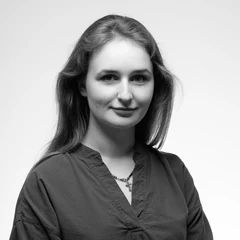
Orthodontic treatment for children and adults: braces and aligners, support at every stage, including the retention period.
Doctor's profile →All articles by this doctor →Clinic on Instagram ↗Find out your own timeline at a consultation
After an examination and imaging the orthodontist will give a range in months for your case and show what it is made of. A consultation costs UAH 690.
Or book by phone 067 478 88 78
Find out your own timeline at a consultation
After an examination and imaging the orthodontist will give a range in months for your case and show what it is made of. A consultation costs UAH 690.
Book now